The camt.029 resolution of investigation: answering a cancellation request when settlement is already final
A camt.029 resolution of investigation closes the case a cancellation request opened. The confirmation codes, the honest rejections, and the workflow.
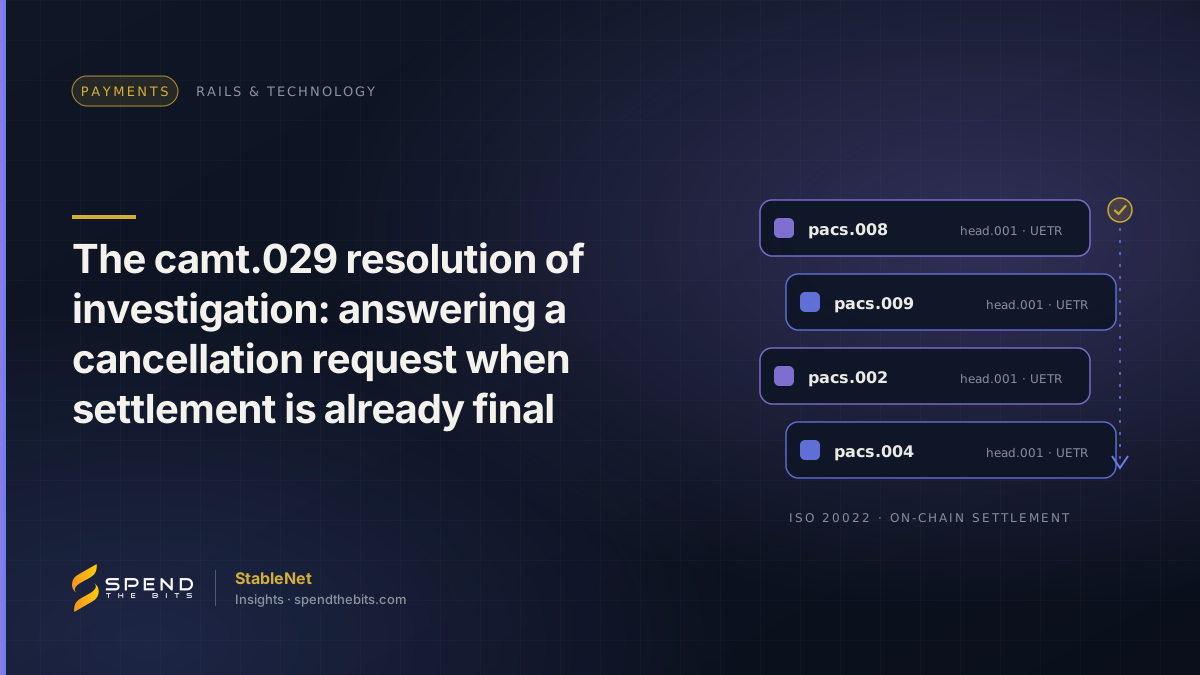
- The camt.029 resolution of investigation is the answer leg of an ISO 20022 exceptions case. It closes a camt.056 or camt.055 cancellation request, and also a camt.026 unable to apply or a camt.027 claim of non receipt.
- It confirms, it does not credit. Funds coming back travel separately as a pacs.004 return with their own identifiers, and the camt.029 only says that the return is coming or has been made.
- Most cancellation traffic resolves to one of three confirmation codes: CNCL for cancelled, RJCR for rejected, and PDCR while the agent waits on its own customer. A rejection must carry a reason such as ARDT, AGNT, CUST, LEGL, NOOR or INDM.
- Once funds are credited the receiving institution cannot reverse them on instruction, so a fast rejection with the right reason beats a slow case that ages in a queue with no answer at all.
- When the settlement leg runs on a public blockchain, finality in minutes makes PDCR and RJCR the usual answers. The control has to clear before the transfer is signed, and the message record, not the ledger, carries the parties.
A cancellation request is only half of a payment investigation. The camt.029 resolution of investigation is the other half, the message that tells the requester what actually happened to the payment. It is the answer leg of the ISO 20022 exceptions and investigations set. In a cross-border operation it decides whether a case closes with money coming back, with a refusal, or with a status and nothing else.
This article sets out what the message is, which answers it can carry, when a rejection is the only honest reply, how the workflow runs day to day, and what changes when the settlement leg ran on a public blockchain. It describes an operating practice, not legal advice.
What is a camt.029 resolution of investigation, and what does it answer?
The camt.029 is the ISO 20022 ResolutionOfInvestigation message. One agent sends it to close, or to update, a case that another agent opened. The case is usually a cancellation request. Between institutions that request travels as a camt.056. From a customer to its own bank it travels as a camt.055. The same answer message also closes a camt.026 unable to apply and a camt.027 claim of non receipt.
The structure is small and it repays reading once. An assignment block names the case, the assigner, the assignee and the time. A status block carries the confirmation, which is the outcome. Where funds come back, a resolution related information block carries the returned amount, the settlement date and the reference of the return. The original payment is identified by its own references, and the UETR ties every message in the case to the same payment.
What the message is not matters just as much. It does not move money. A cancellation agreed after settlement is followed by a pacs.004 return, which is a separate payment with its own identifiers. The camt.029 says a return is coming, or that one has been made. A team that treats the answer as the credit will break its own reconciliation.
Which confirmation codes can a camt.029 carry?
The outcome sits in a confirmation code taken from an external code list that ISO 20022 publishes and updates on a quarterly cycle. Three values carry most cancellation traffic.
CNCL says the payment was cancelled as requested. RJCR says the cancellation request was rejected. PDCR says the request is pending, which in practice means the agent is waiting on its own customer to agree.
A rejection has to say why. The reason comes from the external cancellation rejection code list, and the common values are plain enough to repeat to a client. ARDT says the transaction was already returned. AGNT is a decision by the agent and CUST a decision by the customer. LEGL points at a legal constraint. NOOR says the agent never received the original transaction. INDM says an indemnity is required before anything moves.
The pairing is the useful part. A confirmation code with no reason gives the requester nothing to act on and gives the client nothing to be told. A reason with no confirmation leaves the case open in both books. Operations teams should treat an answer that carries only one of the two as incomplete and chase it.
When is a rejection the only honest answer?
More often than a service level promise suggests, and the reason is simple. Once a payment has been credited to a beneficiary, the receiving institution cannot take the money back on instruction. It has to ask its own customer. If the customer says no, the honest answer is RJCR with the customer decision reason, and it should be sent quickly rather than held while someone hopes for a better outcome.
Three other cases close the same way. A payment already returned is answered with ARDT, because a second return would pay the money twice. A legal or regulatory constraint, including a block on funds, is answered with LEGL, and the detail behind it may not travel in the message. A request that reaches an agent which never saw the original payment is answered with NOOR, which usually means the requester sent the case down the wrong leg.
Speed makes this harder every year. Per the Financial Stability Board's 2021 G20 roadmap targets, 75 percent of cross-border wholesale payments should be credited within one hour of initiation by the end of 2027. The shorter the gap between release and credit, the smaller the share of cases that can end in CNCL at all. Firms that measure cancellation success should expect the number to fall as their own rails get faster.
An investigation answer that arrives late, or that carries a code with no reason behind it, costs the same as no answer at all. The client still has to be told something.
What does a working camt.029 workflow look like day to day?
The answer leg is an operations process with a message at the end of it, not the other way round. The sequence below is the order that keeps cases short.
- Acknowledge the inbound case the moment it lands, and record the case identification, the UETR and the clock start against the payment.
- Find the payment by UETR rather than by name and amount, because a search on party data finds near matches and wastes the window.
- Decide whether the funds are still under your control. Everything after this point follows from that single question.
- If the funds have not been credited and nothing blocks the reversal, stop the payment, then answer CNCL and start the pacs.004 return.
- If the funds have been credited, ask the beneficiary in writing, give the request a deadline, and answer PDCR while the clock runs.
- If the answer is no, or an indemnity is required, send RJCR with the matching reason code instead of letting the case age in a queue.
- Quote the case identification and the original references on every answer, so the requester can match it without a phone call.
- Close the case in your own system with the outcome, the reason, the person who decided and the timestamps, then report the ageing weekly.
Two of those deserve a second look. The deadline given to a beneficiary should be a policy, not a judgement call, because an open ended request is how a case ages past the point where anyone remembers it. And the written answer to the client should reuse the reason code wording. Translating a code into a different story in the client email is how two versions of the same case start circulating.
What changes when the settlement leg ran on a public blockchain?
The case moves earlier, and the honest answer rate changes shape. A stablecoin transfer is final within minutes and cannot be reversed by instruction. There is no queue to pull the payment out of and no intermediary to ask. By the time most cancellation requests arrive, the funds already sit with the beneficiary.
That makes PDCR and RJCR the realistic answers and CNCL the rare one. It is not a weakness of the rail so much as a change in where the control has to sit. Screening, beneficiary verification and duplicate checks have to clear before the transfer is signed, because after signing only negotiation is left.
The record improves in the same move. Every settled transfer carries a hash, an amount and a timestamp that both sides can read. An investigation that would have taken days of correspondence to establish what was sent can establish it in minutes. The remaining work is matching that hash to the obligation, which lives in the firm's own messages rather than on the ledger.
One limitation deserves stating plainly. A public ledger carries no originator or beneficiary data. The pacs.008 customer credit transfer, the pacs.009 interbank leg, the structured address fields and the Travel Rule payload under IVMS101 are the only places the parties appear. An investigation reads those messages, not the chain.
What should the investigation file keep?
Enough for a reviewer to reconstruct the case without asking anyone what happened. That means the inbound request, every answer sent, the beneficiary correspondence, the decision and its author, and the return reference where funds moved.
Two numbers belong in the monthly pack. The first is time to first answer, measured from receipt of the case rather than from the moment someone opened it. The second is the mix of outcomes, split by whether the funds had been credited when the request arrived. Together they show whether cases are being worked or parked, and they are the pair an examiner tends to ask for.
Keep the file at case level and link it to the payment, not the reverse. Cases outlive payments in a review, and a file organised by payment loses the pending answer that explains a long gap.
Where StableNet fits
StableNet, built by SpendTheBits, settles cross-border B2B payments for banks, credit unions, licensed money service businesses, exchange houses and remittance fintechs in regulated stablecoins, completing in minutes with on-chain auditability. Because settlement is final, the controls that would otherwise be tested by an investigation run before release rather than after it. Every transfer is ISO 20022 native, with a pacs.008 for the customer credit transfer, a pacs.009 for the interbank leg, pacs.002 status reports, pacs.004 for returns, a head.001 envelope and one UETR carried end to end. KYB and KYC onboarding, KYT, sanctions and PEP screening and Travel Rule data under IVMS101 sit in the same path and write to a tamper-evident audit trail. That trail is what an investigation answer is built from.
See it on your corridors
Book a working session and we’ll map StableNet’s compliance and settlement to one of your live payment flows.